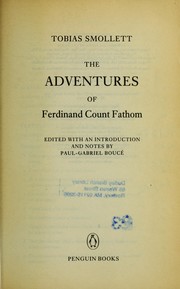
The Adventures of Ferdinand Count Fathom

by T. Smollett

Horror Free eBook Public domain

The Adventures of Ferdinand Count Fathom by T. Smollett is a public-domain horror work, free to read online in full. One of Project Gutenberg's most-downloaded titles. It is catalogued under Adventure stories. A full text excerpt is included below, with EPUB and Kindle editions.

As an Amazon Associate, MyBookPDF earns from qualifying purchases. The Adventures of Ferdinand Count Fathom is free to read and download here; the Amazon (physical copy) and Audible (free-trial audiobook) links are optional.

📥 Download free (PDF, EPUB, Kindle) — Project Gutenberg

Free, public domain, no registration.

More: The Adventures of Ferdinand Count Fathom summary · books like The Adventures of Ferdinand Count Fathom · more by T. Smollett · browse the library.

Read the opening of The Adventures of Ferdinand Count Fathom

PART I. TO DOCTOR CHAPTER ONE. Some sage Observations that naturally introduce our important History CHAPTER TWO. A superficial View of our Hero’s Infancy CHAPTER THREE. He is initiated in a Military Life, and has the good Fortune to acquire a generous Patron CHAPTER FOUR. His Mother’s Prowess and Death; together with some Instances of his own Sagacity CHAPTER FIVE. A brief Detail of his Education CHAPTER SIX. He meditates Schemes of Importance CHAPTER SEVEN. Engages in Partnership with a female Associate, in order to put his Talents in Action CHAPTER EIGHT. Their first Attempt; with a Digression which some Readers may think impertinent CHAPTER NINE. The Confederates change their Battery, and achieve a remarkable Adventure CHAPTER TEN. They proceed to levy Contributions with great Success, until our Hero sets out with the young Count for Vienna, where he enters into League with another Adventurer CHAPTER ELEVEN. Fathom makes various Efforts in the World of Gallantry CHAPTER TWELVE. He effects a Lodgment in the House of a rich Jeweller CHAPTER THIRTEEN. He is exposed to a most perilous Incident in the Course of his Intrigue with the Daughter CHAPTER FOURTEEN. He is reduced to a dreadful Dilemma, in consequence of an Assignation with the Wife CHAPTER FIFTEEN. But at length succeeds in his Attempt upon both CHAPTER SIXTEEN. His Success begets a blind Security, by which he is once again well-nigh entrapped in his Dulcinea’s Apartment CHAPTER SEVENTEEN. The Step-dame’s Suspicions being awakened, she lays a Snare for our Adventurer, from which he is delivered by the Interposition of his Good Genius CHAPTER EIGHTEEN. Our Hero departs from Vienna, and quits the Domain of Venus for the rough Field of Mars CHAPTER NINETEEN. He puts himself under the Guidance of his Associate, and stumbles upon the French Camp, where he finishes his Military Career CHAPTER TWENTY. He prepares a Stratagem, but finds himself countermined—Proceeds on his Journey, and is overtaken by a terrible Tempest CHAPTER TWENTY-ONE. He falls upon Scylla, seeking to avoid Charybdis. CHAPTER TWENTY-TWO. He arrives at Paris, and is pleased with his Reception CHAPTER TWENTY-THREE. Acquits himself with Address in a Nocturnal Riot CHAPTER TWENTY-FOUR. He overlooks the Advances of his Friends, and smarts severely for his Neglect CHAPTER TWENTY-FIVE. He bears his Fate like a Philosopher; and contracts acquaintance with a very remarkable Personage CHAPTER TWENTY-SIX. The History of the Noble Castilian CHAPTER TWENTY-SEVEN. A flagrant Instance of Fathom’s Virtue, in the Manner of his Retreat to England CHAPTER TWENTY-EIGHT. Some Account of his Fellow-Travellers CHAPTER TWENTY-NINE. Another providential Deliverance from the Effects of the Smuggler’s ingenious Conjecture CHAPTER THIRTY. The singular Manner of Fathom’s Attack and Triumph over the Virtue of the fair Elenor CHAPTER THIRTY-ONE. He by accident encounters his old Friend, with whom he holds a Conference, and renews a Treaty CHAPTER THIRTY-TWO. He appears in the great World with universal Applause and Admiration CHAPTER THIRTY-THREE. He attracts the Envy and Ill Offices of the minor Knights of his own Order, over whom he obtains a complete Victory CHAPTER THIRTY-FOUR. He attracts the Envy and Ill Offices of the minor Knights of his own Order, over whom he obtains a complete Victory CHAPTER THIRTY-FIVE. He repairs to Bristol Spring, where he reigns paramount during the whole Season CHAPTER THIRTY-SIX. He repairs to Bristol Spring, where he reigns paramount during the whole Season CHAPTER THIRTY-SEVEN. He repairs to Bristol Spring, where he reigns paramount during the whole Season CHAPTER THIRTY-EIGHT. The Biter is Bit

PART II. CHAPTER THIRTY-NINE. Our Adventurer is made acquainted with a new Scene of Life CHAPTER FORTY. He contemplates Majesty and its Satellites in Eclipse CHAPTER FORTY-ONE. One Quarrel is compromised, and another decided by unusual Arms CHAPTER FORTY-TWO. An unexpected Rencontre, and a happy Revolution in the Affairs of our Adventurer CHAPTER FORTY-THREE. Fathom justifies the Proverb, “What’s bred in the Bone will never come out of the Flesh” CHAPTER FORTY-FOUR. Fathom justifies the Proverb, “What’s bred in the Bone will never come out of the Flesh” CHAPTER FORTY-FIVE. Renaldo’s Distress deepens, and Fathom’s Plot thickens CHAPTER FORTY-SIX. Our Adventurer becomes absolute in his Power over the Passions of his Friend, and effects one half of his Aim CHAPTER FORTY-SEVEN. The Art of Borrowing further explained, and an Account of a Strange Phenomenon CHAPTER FORTY-EIGHT. Count Fathom unmasks his Battery; is repulsed; and varies his Operations without effect CHAPTER FORTY-NINE. Monimia’s Honour is protected by the Interposition of Heaven CHAPTER FIFTY. Fathom shifts the Scene, and appears in a new Character CHAPTER FIFTY-ONE. Triumphs over a Medical Rival CHAPTER FIFTY-TWO. Repairs to the Metropolis, and enrols himself among the Sons of Paean CHAPTER FIFTY-THREE. Acquires Employment in consequence of a lucky Miscarriage CHAPTER FIFTY-FOUR. His Eclipse, and gradual Declination CHAPTER FIFTY-FIVE. After divers unsuccessful Efforts, he has recourse to the Matrimonial Noose CHAPTER FIFTY-SIX. In which his Fortune is effectually strangled CHAPTER FIFTY-SEVEN. Fathom being safely housed, the Reader is entertained with a Retrospect CHAPTER FIFTY-EIGHT. Renaldo abridges the Proceedings at Law, and approves himself the Son of his Father CHAPTER FIFTY-NINE. He is the Messenger of Happiness to his Sister, who removes the film which had long obstructed his Penetration, with regard to Count Fathom CHAPTER SIXTY. He recompenses the Attachment of his Friend; and receives a Letter that reduces him to the Verge of Death and Distraction CHAPTER SIXTY-ONE. Renaldo meets with a living Monument of Justice, and encounters a Personage of some Note in these Memoirs CHAPTER SIXTY-TWO. His Return to England, and Midnight Pilgrimage to Monimia’s Tomb CHAPTER SIXTY-THREE. He renews the Rites of Sorrow, and is entranced CHAPTER SIXTY-FOUR. The Mystery unfolded—Another Recognition, which, it is to be hoped, the Reader could not foresee CHAPTER SIXTY-FIVE. A retrospective Link, necessary for the Concatenation of these Memoirs CHAPTER SIXTY-SIX. The History draws near a Period CHAPTER SIXTY-SEVEN. The Longest and the Last

Titlepage of Part One Frontispiece of Part One He Opened the Repository Titlepage of Part Two Frontispiece of Part Two You Are the Count de Melvil

The Adventures of Ferdinand Count Fathom, Smollett’s third novel, was given to the world in 1753. Lady Mary Wortley Montagu, writing to her daughter, the Countess of Bute, over a year later [January 1st, 1755], remarked that “my friend Smollett . . . has certainly a talent for invention, though I think it flags a little in his last work.” Lady Mary was both right and wrong. The inventive power which we commonly think of as Smollett’s was the ability to work over his own experience into realistic fiction. Of this, Ferdinand Count Fathom shows comparatively little. It shows relatively little, too, of Smollett’s vigorous personality, which in his earlier works was present to give life and interest to almost every chapter, were it to describe a street brawl, a ludicrous situation, a whimsical character, or with venomous prejudice to gibbet some enemy. This individuality—the peculiar spirit of the author which can be felt rather than described—is present in the dedication of Fathom to Doctor ———, who is no other than Smollett himself, and a candid revelation of his character, by the way, this dedication contains. It is present, too, in the opening chapters, which show, likewise, in the picture of Fathom’s mother, something of the author’s peculiar “talent for invention.” Subsequently, however, there is no denying that the Smollett invention and the Smollett spirit both flag. And yet, in a way, Fathom displays more invention than any of the author’s novels; it is based far less than any other on personal experience. Unfortunately such thorough-going invention was not suited to Smollett’s genius. The result is, that while uninteresting as a novel of contemporary manners, Fathom has an interest of its own in that it reveals a new side of its author. We think of Smollett, generally, as a rambling storyteller, a rational, unromantic man of the world, who fills his pages with his own oddly-metamorphosed acquaintances and experiences. The Smollett of Count Fathom, on the contrary, is rather a forerunner of the romantic school, who has created a tolerably organic tale of adventure out of his own brain. Though this is notably less readable than the author’s earlier works, still the wonder is that when the man is so far “off his beat,” he should yet know so well how to meet the strange conditions which confront him. To one whose idea of Smollett’s genius is formed entirely by Random and Pickle and Humphry Clinker, Ferdinand Count Fathom will offer many surprises.

The first of these is the comparative lifelessness of the book. True, here again are action and incident galore, but generally unaccompanied by that rough Georgian hurly-burly, common in Smollett, which is so interesting to contemplate from a comfortable distance, and which goes so far towards making his fiction seem real. Nor are the characters, for the most part, life-like enough to be interesting. There is an apparent exception, to be sure, in the hero’s mother, already mentioned, the hardened camp-follower, whom we confidently expect to become vitalised after the savage fashion of Smollett’s characters. But, alas! we have no chance to learn the lady’s style of conversation, for the few words that come from her lips are but partially characteristic; we have only too little chance to learn her manners and customs. In the fourth chapter, while she is making sure with her dagger that all those on the field of battle whom she wishes to rifle are really dead, an officer of the hussars, who has been watching her lucrative progress, unfeelingly puts a brace of bullets into the lady’s brain, just as she raises her hand to smite him to the heart. Perhaps it is as well that she is thus removed before our disappointment at the non-fulfilment of her promise becomes poignant. So far as we may judge from the other personages of Count Fathom, even this interesting Amazon would sooner or later have turned into a wooden figure, with a label giving the necessary information as to her character.

Such certainly is her son, Fathom, the hero of the book. Because he is placarded, “Shrewd villain of monstrous inhumanity,” we are fain to accept him for what his creator intended; but seldom in word or deed is he a convincingly real villain. His friend and foil, the noble young Count de Melvil, is no more alive than he; and equally wooden are Joshua, the high-minded, saint-like Jew, and that tedious, foolish Don Diego. Neither is the heroine alive, the peerless Monimia, but then, in her case, want of vitality is not surprising; the presence of it would amaze us. If she were a woman throbbing with life, she would be different from Smollett’s other heroines. The “second lady” of the melodrama, Mademoiselle de Melvil, though by no means vivified, is yet more real than her sister-in-law.

Continue reading The Adventures of Ferdinand Count Fathom free →