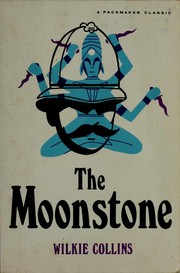
The Moonstone
Often called the first English detective novel: a cursed Indian diamond vanishes, and many narrators piece together the theft.
As an Amazon Associate, MyBookPDF earns from qualifying purchases. The Moonstone is free to read and download here; the Amazon (physical copy) and Audible (free-trial audiobook) links are optional.
Download free (PDF, EPUB, Kindle) — Project Gutenberg
Free, public domain, no registration.
More: The Moonstone summary · books like The Moonstone · more by Wilkie Collins · browse the library.
Read the opening of The Moonstone
I address these lines—written in India—to my relatives in England.
My object is to explain the motive which has induced me to refuse the right hand of friendship to my cousin, John Herncastle. The reserve which I have hitherto maintained in this matter has been misinterpreted by members of my family whose good opinion I cannot consent to forfeit. I request them to suspend their decision until they have read my narrative. And I declare, on my word of honour, that what I am now about to write is, strictly and literally, the truth.
The private difference between my cousin and me took its rise in a great public event in which we were both concerned—the storming of Seringapatam, under General Baird, on the 4th of May, 1799.
In order that the circumstances may be clearly understood, I must revert for a moment to the period before the assault, and to the stories current in our camp of the treasure in jewels and gold stored up in the Palace of Seringapatam.
One of the wildest of these stories related to a Yellow Diamond—a famous gem in the native annals of India.
The earliest known traditions describe the stone as having been set in the forehead of the four-handed Indian god who typifies the Moon. Partly from its peculiar colour, partly from a superstition which represented it as feeling the influence of the deity whom it adorned, and growing and lessening in lustre with the waxing and waning of the moon, it first gained the name by which it continues to be known in India to this day—the name of THE MOONSTONE. A similar superstition was once prevalent, as I have heard, in ancient Greece and Rome; not applying, however (as in India), to a diamond devoted to the service of a god, but to a semi-transparent stone of the inferior order of gems, supposed to be affected by the lunar influences—the moon, in this latter case also, giving the name by which the stone is still known to collectors in our own time.